Metabolomics, also known as metabolic profiling, offers the best and most direct measure of physiological activity. It is a perfect vehicle for exploring any system that fundamentally relies on a biochemical foundation.
- Biomarker Discovery
- Pharmaceutical Discovery
- Drug Development
- Lead Optimization
- Bioprocessing Optimization
- Media Optimization
- Physiological Exploration
- Disease Diagnostics
- Agricultural Improvements
- Food and Diet Evaluation
- Toxicology Studies
About Metabolomics
Metabolomics is both the newest and the oldest of the omics sciences. It is considered the newest of the omics sciences as recent advances in mass spectral techniques have enabled the global measurement of biochemical molecules (metabolites); it is the oldest because biochemists have been examining the overall biochemical balance of an organism for well over fifty years.
Because it establishes the overall biochemical status of all of the metabolites (or biochemicals) of a biological sample, it is the truest direct measure of the phenotype of the cell. For this reason it has captured the imagination of researchers, biomedical institutions, and governmental bodies around the world. Metabolites cross a wide range of molecular classes including amino acids, nucleotides, antioxidants and sugars. The study of metabolomics enables researchers to evaluate how a cell is functioning in healthy or diseased states, as well as to analyze the cell’s response to a foreign stimulus such as a drug, toxin or environmental change. This response is measured by identifying the changes in concentration of the cell’s metabolites after exposure to a stressor. The discovery of sarcosine as a biomarker for prostate cancer aggressiveness (http://www.ncbi.nlm.nih.gov/pmc/articles/PMC2724746/?tool=pubmed) represents the potential that metabolomics may play in detailing disease mechanism, toxicity, drug or stress responses.
Figure: Illustration of the flow of genetic information from DNA to Metabolites, which are biochemicals that are the building blocks and by-products of a cell’s activities. The concentrations of metabolites in a cell give information as to the ‘health’ of a cell.
Currently, most metabolomics studies are performed in a three-step process: sample preparation, mass spectroscopy processing, and data interpretation. Significant energy and expertise are required to design and optimize these experiments as well as to interpret the output data from the instrument. Even though metabolomics is the simplest of the omics sciences, with relatively few well-defined entities, the data analysis step for a particular study can require weeks of expensive PhD-level chemistry expertise for metabolite identification. While current metabolomics techniques are flawed, considered noisy and statistically difficult to achieve success, advancements will improve the ability of the investigator to use metabolomics easily and assuredly find answers to a wide variety of problems.
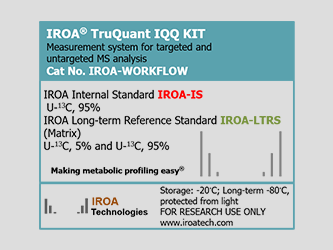
The IROATM technology is the most significant development in the advancement of metabolomics in recent years. It has been referred to as the PCR of metabolomics. Use of the IROA methodologies simplifies metabolomics studies and greatly shortens data analysis. It makes it possible for anyone to perform metabolomics and to achieve a high level of qualitative data output in specialized metabolomic applications.
target="_blank">
alt="wordpress stats plugin" >